Modern Cataract Surgery-New Technologies and Costs

(If necessary, familiarize yourself with cataracts by reading the related article on our website)
Cataract surgery is one of the most common surgeries performed around the world. It is one of a few unique procedures where dramatic changes for the better
(clear vision and enhanced colour vision) are noticed in a short period of time after the surgery.
New technologies using laser systems and different types
of lens implants are now available to provide better outcomes, reduce complications and provide different types of vision correction.
Laser Assisted Cataract Surgery
Laser instrumentation can now play a major role during cataract surgery. Several incisions are made within the eye tissues during the procedure. All of these incisions were traditionally done by a scalpel blade. Use of the laser allows for thinner and more consistent length and depth of incisions. The laser can also be used to break up the cataract much more efficiently and quickly compared to conventional ultrasonic means. Using the laser will help to speed up healing and reduce the risk of complications as the eye is less traumatized and not opened for any longer than necessary. Overall, laser assisted cataract surgery has been demonstrated to improve accuracy, safety and provide more predictable outcomes for vision and eye health.
Intraocular Lens Implants (IOL's)
The IOL is a man-made plastic implant that replaces the cataract within the eye. Lens material and vision designs have been the main technological advances help improve post cataract vision and eye health.
- IOL Materials
- IOL Vision Options
- Spherical Distance IOL
- Aspheric Distance IOL
- Astigmatism IOL
- Presbyopia IOL
Different types of plastic polymers have evolved over the years, the main advances coming in ultraviolet (UV) protection and softer materials. The softer material allows the implant to be foldable so smaller eye incisions can be made so the implant can be inserted into the eye and then unfold itself when final positioning is done within the eye.
While the main priority in cataract surgery is to remove the cloudy lens of the eye, vision correction is usually incorporated into the IOL. There are now several options to correct distance and near vision.
This is the basic type of IOL where the distance vision correction is incorporated for both eyes to target 20/20 vision for distance. Reading glasses would be necessary for computer and reading.
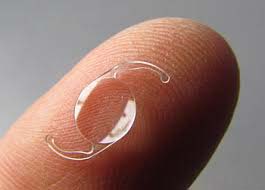
(Actual IOL Size)
An upgrade from the spherical IOL where the aspheric IOL surface is specially curved to reduce vision aberrations to provide clearer distance vision, similar to HDTV.
Patients who have a moderate to high amount of astigmatism would need this type of IOL to closer achieve 20/20 vision at distance.
There are various designs of presbyopia IOL's now available that attempt to achieve clear vision at all distances (far, intermediate and near) without having to use any glasses. Caution-while this technology is currently available, this type of IOL may not be suitable for all patients. Patient selection must be very specific to see if this IOL will meet each patient's own unique vision demands, i.e., golfing vs. sewing.
Another presbyopic IOL option is called monovision. In this case, a distance vision correcting IOL is placed in one eye and a near vision correcting IOL is placed in the other eye. Again, patient selection must be very specific as not every patient can adjust to having different vision between the two eyes.
Costs
When cataract surgery is approved, it is deemed to be 'medically necessary' and full cost is covered by the Alberta Health Care Insurance Plan (AHCIP). But included in this definition is coverage for standard operation procedures using a scalpel blade and distance vision IOL's.
Laser assisted cataract surgery and different IOL options above the standard IOL are not covered by AHCIP and the patient is responsible for these costs if they are chosen. There is variability in costs between the various IOL's as each performs a different function. There is also variability in laser and IOL costs between cataract surgeons. Since every cataract situation is different, we encourage patients to ask their Optometrist what options are best for them.

General information
More Than Just Eye Examinations
Dominica...Working Beyond Borders
Eye Health
Blepharitis-Common Eye Condition
Optical Coherence Tomography (OCT)
Vision
Children's Vision: Back to School
General information
Why Choose Calgary Optometry Centre
Glasses information
Selecting Eyewear for your Face
Lens information
Understanding Your Optometrist's Lens Recommendations
Sunglasses-Protecting your Eyes from Harm
Transitions Lenses…Right in any Light
Seecoat…A New Standard for Anti-Reflective (AR) and Scratch Resistance (SR) Lens Coating
General information
Help for Contact Lens "Dropouts"
Types of Lenses
Soft Contact Lenses: Not All the Same
Daily Disposable Contact Lenses for Spring...even in Colours
Vision