Understanding your Optometrist's Lens Recommendations
 Your optometrist may have just recommended a new prescription to improve your vision. For example, "high index progressive lenses in a plastic material with transitions tint" may be recommended for everyday wear. Additionally, "online lenses with a Nikon coating" may be advised for computer screen work.
All these terms can leave you feeling a little puzzled and overwhelmed. Here is a summary to guide you through the language of lens and coating options.
Glass or Plastic?
| Feature | Glass | Plastic |
| Weight | Heavier | Lighter |
| Lens thickness | Thinner | Thicker |
| Impact resistance | Breaks easier | Less breakage |
| Scratch resistance | More resistant | Scratches easier |
As you can see, there are advantages and disadvantages to each material depending on the specific feature. In the majority of cases, we recommend plastic lenses for safety reasons.
What about high index?
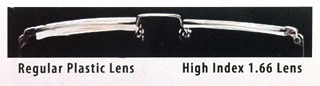 High index lenses are considered for stronger lens prescriptions to reduce the thickness and weight of the lenses. These lenses can reduce lens thickness and weight by up to 50% when compared to standard lenses (depending on lens strength). High index lenses are available in both plastic and glass materials. This technology has virtually eliminated the "thick coke bottle lenses" seen in the past.
Bifocal, Progressive and Online lenses
 Both these lens designs contain separate prescription zones for distance and near vision within the same lens. A bifocal lens separates these zones with a distinct line through the lens, while a progressive and online lens has no visible lines.
Photochromic and Transitions lenses
These lenses have a variable tint intensity depending on light and temperature conditions. In bright sunlight and colder temperatures, the lenses darken like a sunglass. Indoors the lenses will become clearer. These lenses are a practical alternative to having a separate pair of prescription sunglasses. More about Transitions Lenses
Anti-reflection Coating
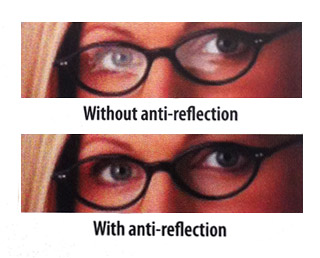
This lens coating eliminates distracting glare created when light is reflected from the lens surface. More light will be transmitted to your eyes providing clearer, crisper vision, especially for night driving and computer screen viewing. This coating will also improve the cosmetic appearance as your eyes will be more visible through the lenses.
Scratch resistant Coating
This is recommended for plastic lenses to prevent scratch damage from every day use. This coating is not scratch proof!
Nikon Coating
A brand name, all- in-one coating that combines anti-glare, scratch resistance and water/oil resistance qualities. We recommend this coating on almost all our lenses to provide the most comprehensive lens performance-seeing better, looking better and longer lasting lenses.
Your lenses are the key element to your glasses. Our optometrists will always recommend the most appropriate lenses and coatings to meet your everyday vision and lifestyle needs. If you have any questions about lens and lens coating technology, please call on our doctors or staff members.

General information
More Than Just Eye Examinations
Dominica...Working Beyond Borders
Eye Health
Blepharitis-Common Eye Condition
Optical Coherence Tomography (OCT)
Vision
Children's Vision: Back to School
General information
Why Choose Calgary Optometry Centre
Glasses information
Selecting Eyewear for your Face
Lens information
Understanding Your Optometrist's Lens Recommendations
Sunglasses-Protecting your Eyes from Harm
Transitions Lenses…Right in any Light
Seecoat…A New Standard for Anti-Reflective (AR) and Scratch Resistance (SR) Lens Coating
General information
Help for Contact Lens "Dropouts"
Types of Lenses
Soft Contact Lenses: Not All the Same
Daily Disposable Contact Lenses for Spring...even in Colours
Vision